Why Affirmations Don't Work (And What Actually Does)
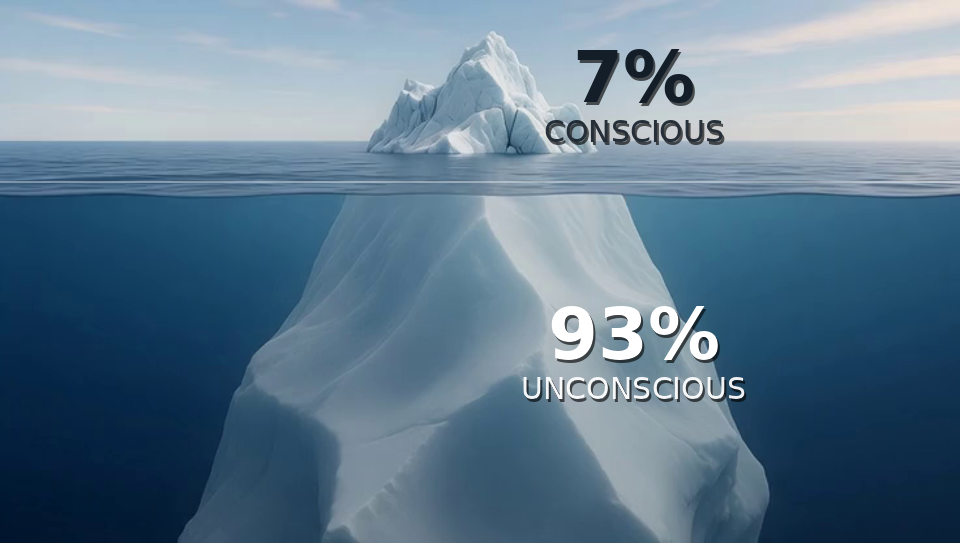
Affirmations don't work because they talk to the part of your mind that was never the problem. Your conscious mind listens, agrees, and means it. Then the unconscious 93% carries on running the old pattern as if nothing was said. Learning to work with that 93% is the unconscious advantage.
If you have already read books on goals and learned about affirmations, you have probably already stood in front of the mirror telling yourself this time will be different, and for a while, it is. Then times passes and the motivation fades. The old pattern comes back. You're right where you started, wondering what's wrong with you.
Nothing is wrong with you. The problem is where you've focussed.
Key Takeaways
- Affirmations and willpower work on the conscious mind, which makes up a small fraction of what actually drives your behaviour
- The relapse cycle (motivated, then a slip, then giving up) isn't a discipline failure, it's a sign the unconscious pattern was never altered
- Your unconscious mind holds identity, emotional conditioning, language patterns, perceptual filters, and physiological state, not just vague "beliefs"
- NLP techniques like anchoring, reframing, and identity work target the unconscious directly, which is why the change feels different and tends to last
The Part of the Iceberg You Can't See
Picture an iceberg. Roughly 7% sits above the water. That's your conscious mind, the part that sets goals, reads self-help books, and is reading this sentence right now.
The other 93% sits below the surface. That's your unconscious mind: your beliefs, your identity, your unconscious patterns, the automatic reactions that fire before you've had a chance to think. It runs most of your behaviour without asking your permission first.
This is one of the most consistent findings in cognitive science and therapeutic practice. Your conscious mind feels like it's steering because it narrates everything that happens. But narrating a decision and making it are two different things.
Think about the last time you knew exactly what you should do and did the opposite anyway. Or reacted before you'd even had time to think it through. In every one of those moments, your conscious 7% understood the situation perfectly well. Your unconscious 93% ran the response regardless.
Why Willpower and Positive Thinking Usually Fail
Willpower is a conscious-mind tool. So is a written affirmation. So is a vision board. They can work for a while, but they're fighting against programming that never changed, and that's an exhausting fight to keep having every morning.
Here's the cycle most people know too well. You feel motivated after a book, a podcast, or a course. You make real changes for a few days, sometimes a few weeks. Then a stressful period hits, or you're back in the environment where the old habit lives, and you slide back into the pattern you were trying to leave. You conclude you lack discipline, or that you "just aren't ready."
That conclusion is almost always wrong. What you're missing isn't willpower. It's access to the level where the pattern was actually installed.
I hear a version of this from people constantly: "I know exactly what to do, I just don't do it." They've done enormous amounts of conscious-mind work. They're not lazy and they're not broken. They're trying to steer a ship using only the tip of the iceberg.
Positive thinking runs into the same wall. Telling yourself you're confident doesn't rewrite an unconscious belief that you're not safe, not enough, or not permitted to succeed. The affirmation sits on the surface. The old programme keeps running underneath it, and when the two contradict each other, the unconscious one wins almost every time.
What Actually Lives in the 93%
The unconscious mind isn't a vague, mystical black box. In practical terms, it holds a small number of specific things.
Identity. Not what you'd say about yourself in a job interview. What you act as if is true. "I'm not the kind of person who finishes things" is an unconscious identity statement wearing the disguise of an opinion.
Emotional conditioning. Past experiences stored as automatic responses. A tone of voice or a situation that "should" be fine, and your body reacts before your mind has caught up.
Language and self-talk. The words you use when you're not performing positivity for anyone. The questions you habitually ask yourself. The metaphors you use to describe your own problems, which often reveal the structure holding them in place.
Perceptual filters. What you notice and what you miss without ever registering it. Two people standing in the same room, quite literally seeing two different situations.
Physiological state. Posture, breathing, muscle tension. State isn't separate from mind. It's part of the same system, and it changes what's available to you before a single thought has formed.
In NLP, much of this gets explored through anchoring, the meta-model, and identity-level work, tools built specifically to work on what's normally invisible. If any of that's unfamiliar, what NLP actually is is a good place to start before going further here.
The point isn't to memorise terminology. It's to recognise that your unconscious behaviour follows structure and a pattern. And anything that follows a pattern can be examined and changed.
If you want to see how this works with something as specific as your sense of self, how identity-level change actually works goes into that in more depth.
Why Most Personal Development Only Reaches the Surface
Walk into any bookshop and you'll find shelves aimed squarely at the conscious 7%. Habit trackers. Morning routines. Atomic Habits, Productivity hacks, Manifestation journals. "Just believe in yourself" messaging on a mug.
None of it is worthless. Surface-level tools have their place. But they weren't built to reach the deeper drivers that keep people stuck, and that's precisely why someone can read every bestseller, attend every seminar, and hire every coach, and still feel that real change never quite lands. They've been working on the narrator. Not the operating system.
I often speak to rooms of fully committed, capable people that go through exactly this. Every one of them had "tried everything" consciously. Books, apps, accountability partners. Three emotions come to the surface: frustration, overwhelm, and a feeling of conflict. All of them are rooted in unconscious patterns, and all of them can be resolved. What actually makes a difference isn't more information. It's working at the level where the pattern resides: at that unconscious level of language, state, and identity, not just the to-do list sitting on top of it.
How NLP Gets You Access to the Unconscious
Neuro-Linguistic Programming was developed in the 1970s by studying what exceptional therapists and communicators did differently from everyone else. Richard Bandler and John Grinder weren't interested in theory for its own sake. They wanted to know how change actually happened, at the level of language and unconscious processing, not just intention.
That origin matters, because NLP was never a positive-thinking movement. It's a modelling discipline built around the gap between the conscious and unconscious mind: how you encode experience, how your language reveals structure you can't see directly, and how state, belief, and identity can shift once you're working with the right lever.
In practice, that means tools like:
- Anchoring, understanding how a state gets linked to a trigger, and how that link can be deliberately changed
- The meta-model, precise questions that recover what's been deleted, distorted, or generalised in someone's own language
- Reframing, changing the meaning of an experience without denying what happened
- Identity and timeline work, addressing where a belief actually formed, and updating it at the root instead of arguing with the surface
This isn't a claim that only NLP reaches the unconscious. Plenty of serious therapeutic traditions get there through different doors. The distinction is precision: NLP was built to work at that level from day one, not as an afterthought.
If you've come across NLP before and felt sceptical, that's fair. It's been marketed badly for decades and often taught worse. Why NLP often falls short on lasting results covers exactly that problem. Done properly, it's a different conversation entirely.
What Changes When You Work Below the Surface
When change reaches the 93%, it has a different texture to it. Less white-knuckling. Less starting over every Monday. Less of that sick feeling that one bad week has erased three months of progress. It feels like a sense of Flow.
I've watched this pattern for three decades now, in individual work and with entire teams. Someone arrives having genuinely tried everything at the conscious level. A few sessions of working structurally, with language, state, or identity, and something shifts that years of affirmations never touched. Not because they finally "wanted it enough." Because they finally worked at the level where the pattern actually lived.
Calum came to me because he had crippling anxiety. He would have panic attacks when he spoke to new people, but he was determined and had incredible willpower. He pushed himself into scenarios that were hard and forced himself to do hard things. It didn't work. His approach of willpower and pushing through the embarrassment left him broke, and he ended up giving up on his dream of becoming an entrepreneur and moved home. When I met him he was earning £300 a month flipping burgers outside Belfast. He attended our live training, and after four days he had let go of deep patterns of identity that no longer served him. It was like plugging in a fresh set of batteries into his psyche. He was fired up with constant energy and motivation. Over the next 18 months he set up a new business called Rising Influence and grew it to almost six figures. The transformation in his confidence is genuinely impressive to see, not to mention his personal and business growth.
Working at the unconscious level isn't about bypassing responsibility or logic. It's not about willpower or pushing through. It's about getting what you consciously want and what you unconsciously align in the same direction. Once those two line up, behaviour stops feeling like a daily battle against yourself.
Where to Start Today
You don't need a practitioner to take the first step. Three things you can do right now.
Stop blaming willpower. Next time you slip, ask what unconscious belief or state got triggered, not what's wrong with your character.
Listen to your own language. The way you describe a problem often contains the exact structure that's keeping it in place. "I'm not good, I can't, I'm stupid" are all unnecessary identity statements that need to be deprogrammed.
Learn how your mind actually works before collecting more techniques. Understanding beats accumulation every time.
The iceberg isn't a reason to feel hopeless. It's a map. And a map is only useful once you know which part of the territory you've actually been trying to change, and which part you've been quietly ignoring the whole time.
Frequently Asked Questions
Why don't affirmations work?
Affirmations assert a desired belief while the existing, contradictory belief stays exactly where it was. If you affirm "I am confident" while an unconscious belief says otherwise, your mind registers the contradiction and tends to reinforce the older, stronger belief rather than replace it.
What's the difference between the conscious and unconscious mind?
The conscious mind is the small part of you that sets intentions, makes plans, and narrates your experience. The unconscious mind is everything running underneath that: identity, emotional conditioning, language patterns, perceptual filters, and physiological state. It's estimated to account for the vast majority of what actually drives behaviour.
Can you actually change your unconscious mind?
Yes, but not by arguing with it consciously. Techniques that work at the structural level, like anchoring, reframing, and identity work, can update the pattern at its source rather than layering a new belief on top of an unchanged one.
How is NLP different from positive thinking?
Positive thinking asserts a desired state without addressing what's underneath it. NLP was built specifically to work with the structure of the unconscious mind, using language and state-based techniques to find and shift the pattern itself.
Why do I know what to do but still not do it?
That gap is the clearest sign the pattern you're fighting lives in the unconscious 93%, not the conscious 7%. Your conscious mind understands the situation. Something else is running the response.
The Real Work Starts Below the Surface
The identity-shifting and personal development conversation has done something genuinely useful. It's put the limits of surface-level change on the map for a lot of people who'd never questioned it before.
What most of that conversation is still missing is the actual toolbox for reaching the 93%, the unconscious advantage most personal development never gets close to.
Building that advantage is exactly the kind of work we explore every week inside Mindset Mastery, a live community for people who are done working on the narrator and ready to work with the part of the mind that actually runs the show. If that sounds like where you are, get in touch and we'll figure out together whether it's the right next step.
Comments